How Climate Affects the Integrity of Designer Bags
Designer Bag Climate Preservation is an essential part of protecting the craftsmanship, appearance, and long-term condition of luxury handbags. A bag made from carefully finished Togo leather, textured caviar leather, delicate lambskin, or an exotic skin can respond differently to humidity, temperature changes, and prolonged exposure to light. Even when a handbag is rarely carried, the environment in which it is stored can influence its flexibility, surface finish, stitching, lining, and metal hardware.
Climate preservation is not simply a matter of keeping an expensive accessory inside a dust bag. It requires understanding the relationship between a material's natural properties, the surrounding atmosphere, and the way a handbag is handled during storage. These factors also matter to collectors who evaluate condition, authenticity, and resale potential. Although no storage method can eliminate aging entirely, informed environmental management can reduce avoidable deterioration without compromising the original character of the piece.
Why Climate Conditions Matter to Luxury Handbag Integrity
A luxury handbag is a combination of materials rather than a single, uniform object. Its exterior may be leather or a coated textile, while its interior contains fabric, adhesives, reinforcement panels, and structural components. Thread, edge paint, decorative coatings, zippers, clasps, and chains introduce additional materials, each with its own response to environmental exposure.
Leather is particularly sensitive because it is a natural material with a fibrous structure that interacts with moisture. Temperature affects the rate of chemical reactions and the movement of moisture through materials, while light can gradually alter dyes and surface finishes. Hardware may be more vulnerable to condensation, corrosion, or changes in protective coatings than the leather surrounding it.
The central preservation principle is therefore straightforward: maintaining a reasonably stable, clean indoor environment is generally more useful than repeatedly moving a bag between contrasting conditions. A collector does not need to create a museum-grade enclosure for every handbag. Instead, the appropriate level of control depends on the material, the local climate, the value of the collection, and the presence of existing damage.
Humidity: The Balance Between Excess Moisture and Excessive Dryness
Relative humidity describes how much water vapor the air contains compared with the maximum amount it could hold at the same temperature. It is especially relevant to leather handbags because both excessive moisture and prolonged dryness can create problems, although the resulting damage is not identical.
What excessive humidity can do
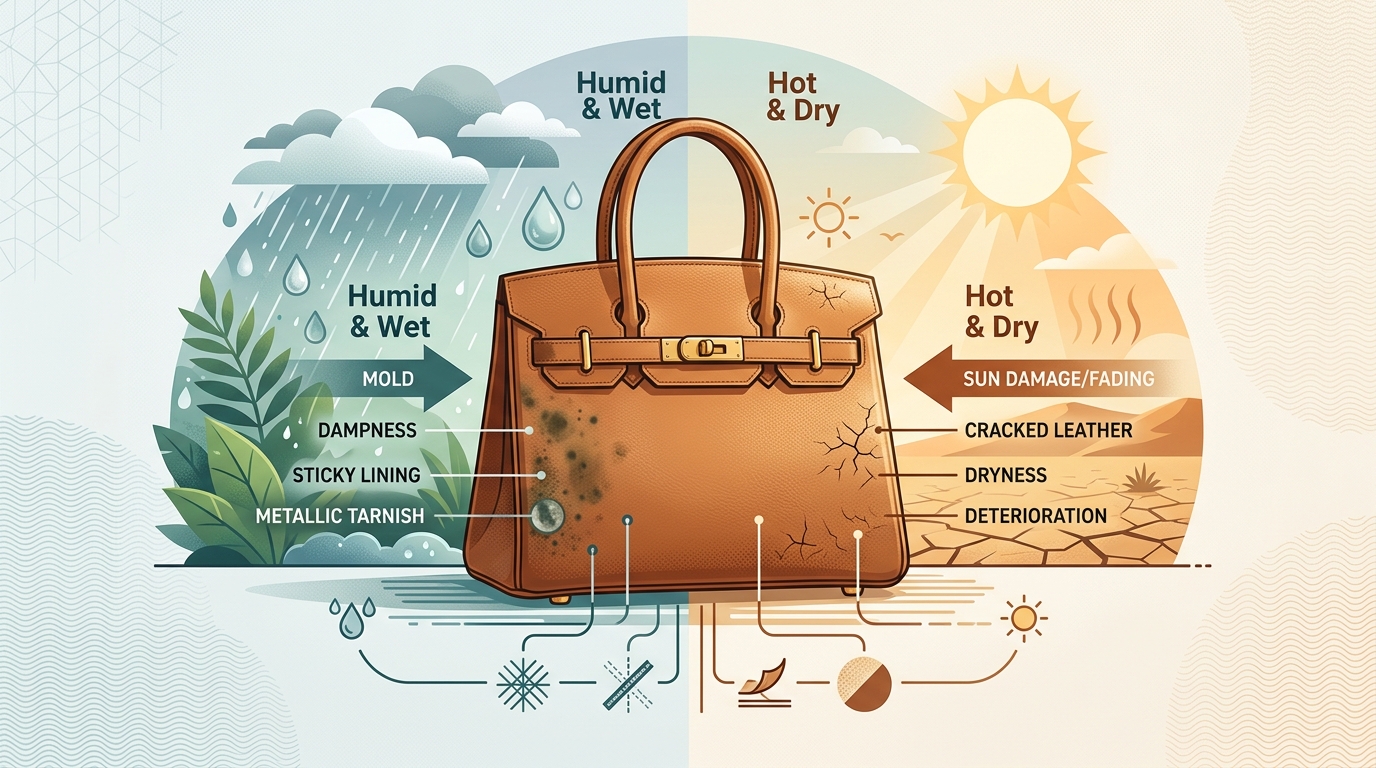
Persistently damp conditions can encourage mold growth when suitable organic materials, moisture, and other favorable conditions are present. Leather, dust, textile linings, and residue from handling can all contribute to an environment in which mold may develop. Visible signs can include fuzzy deposits, unusual spotting, musty odors, or changes in surface appearance. Some discoloration may remain even after the immediate moisture problem has been addressed.
High humidity can also contribute to corrosion on susceptible metal components, especially when moisture condenses on hardware or protective finishes are already compromised. The risk depends on the particular metal, its coating, existing wear, and the duration of exposure. It would be inaccurate to assume that every gold-tone, palladium-tone, or silver-colored fitting will react in exactly the same way.
For example, a handbag stored in a humid closet against an exterior wall may face a different risk from one kept in a well-ventilated interior room. The relevant question is not simply whether the regional climate is humid. It is whether the actual storage location remains damp, experiences condensation, or develops persistent musty conditions.
Why very dry storage is not automatically safer
Reducing humidity can be useful in a damp environment, but aggressive drying introduces its own concerns. Leather contains moisture and oils that contribute to its flexibility and surface characteristics. Prolonged exposure to very dry conditions, particularly when combined with heat or direct airflow, may contribute to stiffness, surface cracking, or deterioration of certain finishes.
These effects vary by leather type, tanning process, finishing method, age, and previous care. Dryness alone does not prove that a particular crack or surface defect was environmentally caused. Existing damage, inappropriate cleaning products, repeated bending, and natural aging can produce similar symptoms.
For routine residential storage, a commonly used starting range is approximately 40% to 55% relative humidity, provided the space is free from condensation and remains reasonably stable. This is a practical reference range rather than a universal manufacturer specification or a guarantee against damage. Particular materials, local building conditions, and conservation requirements may call for a different approach.
A simple digital hygrometer can help establish whether a closet or cabinet is consistently damp or unusually dry. If readings rise substantially after rain or during seasonal changes, address the room's underlying moisture problem rather than placing powerful desiccants directly beside the handbag.
Temperature Fluctuations and the Stability of Leather, Adhesives, and Structure
Temperature affects more than comfort. It influences moisture movement, material flexibility, and the rate at which some aging processes occur. The greatest practical concern for many household collections is prolonged exposure to unsuitable temperatures or repeated transitions between cold and warm environments.
High temperatures may accelerate the deterioration of some adhesives, synthetic components, coatings, and finishes. Heat can also increase moisture loss from leather and contribute to dimensional changes in composite materials. A handbag left in a sunlit car, near a radiator, beside a heating vent, or in a poorly insulated attic is exposed to conditions that differ substantially from a stable indoor closet.
Cold conditions require a more nuanced interpretation. A cool room is not inherently harmful to every handbag, and lower temperatures do not automatically damage leather. Problems become more likely when cold storage is accompanied by dampness, unsuitable freezing conditions, or rapid transitions that create condensation as the bag returns to a warmer environment.
For most occupied homes, a comfortable, stable room temperature is a sensible starting point. Avoid placing a bag close to direct heat sources, and do not use a hair dryer, space heater, or heated cabinet to dry a damp handbag. If a bag arrives from a cold delivery vehicle, allow it to acclimate gradually in a dry indoor environment before opening its storage enclosure or applying any care products.
Why stable conditions can matter more than a single reading
A temperature reading records one moment. It does not reveal what happened overnight, during a heat wave, or when the room's heating system switched on. Repeated fluctuations can affect materials differently from a consistently moderate environment, particularly when temperature changes coincide with changes in relative humidity.
This distinction is useful for collectors who store bags in seasonal homes, basement rooms, or cabinets positioned near windows. If the temperature is comfortable during a daytime inspection but the storage area becomes very hot in the afternoon, the snapshot alone offers an incomplete picture.
When environmental concerns are suspected, monitor the storage location over several days and note significant changes. If a bag develops an unexplained odor, visible mold, sticky coating, or newly distorted structure, investigate the environment and seek qualified assessment rather than assuming temperature is the only cause.
Light Exposure: Fading, Surface Changes, and Uneven Aging
Light can gradually change the appearance of leather dyes, pigments, textiles, and certain protective finishes. Ultraviolet radiation is a particular concern, but visible light and heat associated with strong sunlight can also contribute to deterioration. The extent of the effect depends on the material, its colorants, the intensity and duration of exposure, and the type of finish.
Dark leather is not immune to fading, and light-colored leather is not necessarily the only material at risk. A black handbag may lose visual depth or develop an uneven finish, while a brightly colored bag may show a noticeable shift in tone. Natural and exotic skins may have additional sensitivities related to their surface treatments and pigmentation.
Direct sunlight through a window can create localized problems even when a room feels cool. A bag positioned on an open shelf may receive hours of repeated exposure, while the portion covered by a handle, flap, or accessory remains relatively protected. The result can be an uneven color difference that is difficult to reverse.
Indirect lighting is generally preferable for displaying a collection. For long-term storage, a clean, breathable dust bag and a location away from direct sunlight provide a straightforward layer of protection. Display lighting should be chosen and positioned with attention to heat and exposure duration rather than appearance alone.
Collectors should also remember that a dust bag is not a substitute for climate control. It may reduce dust and direct light exposure, but it cannot correct a damp cabinet or prevent excessive heat from affecting the surrounding environment.
What Official Conservation Guidance Can—and Cannot—Tell Handbag Owners
Conservation guidance provides a useful foundation for environmental decisions because it distinguishes between established deterioration mechanisms and claims that exceed the available evidence. Museum and conservation institutions commonly emphasize stable environmental conditions, protection from direct light, moisture management, and material-specific care.
The Smithsonian Institution's Museum Conservation Institute provides technical information on the preservation of museum objects and the environmental factors that can influence their condition. The Canadian Conservation Institute also publishes conservation guidance addressing relative humidity, temperature, light, and the risks associated with environmental fluctuations. These resources support the broader principle that the environment should be managed according to the object's materials and vulnerabilities rather than by applying one rule to everything.
However, conservation recommendations developed for collections cannot automatically be treated as manufacturer-approved specifications for every luxury handbag. Museum objects may have different materials, historical significance, monitoring systems, and conservation resources from a privately owned accessory. A guideline designed for a collection of paintings, archival materials, or mixed-material artifacts may not establish a precise safe threshold for a specific leather treatment or exotic skin.
The most defensible interpretation is to use established conservation principles as a framework, then consider the handbag's construction and documented care instructions. If a brand provides specific instructions for a particular leather or finish, those instructions deserve priority over generic online advice. If the material is rare, unusually fragile, or already deteriorating, a conservator experienced with leather and composite objects can help determine whether more specialized controls are justified.
Separate evidence from assumptions
Several practical distinctions prevent unnecessary intervention:
- Supported principle: prolonged direct light can contribute to fading and other light-related deterioration.
- Reasonable interpretation: storing a colored handbag away from a sunny window reduces avoidable exposure.
- Claim requiring more evidence: every designer handbag must be kept at one exact temperature and humidity level regardless of material or construction.
- Important limitation: a new scratch, crease, or color change does not by itself establish that climate conditions caused the defect.
This distinction matters when evaluating a handbag's condition for insurance, collection records, or resale. Environmental damage is one possible explanation for a change, not a diagnosis that can be made from a photograph or a single humidity reading alone.
Material-Specific Responses: Togo, Caviar, Lambskin, and Exotic Skins
Luxury handbags are often described by their leather names, but those labels do not provide a complete picture of environmental tolerance. Tanning methods, pigments, embossing, surface coatings, finishing products, construction, and previous treatments can all influence the response of a particular bag.
Togo leather
Togo is commonly associated with a pronounced grain and a relatively structured, textured appearance. Its grain can make minor surface irregularities less visually prominent than on some smoother leathers, but texture should not be mistaken for immunity to moisture, heat, or sunlight.
Prolonged dampness can still affect the surface, seams, and interior materials. Repeated exposure to unsuitable conditions may alter the leather's feel or appearance. Gentle handling, stable storage, and prompt attention to moisture problems remain more defensible than assuming the grain provides complete protection.
Caviar leather
Caviar leather is commonly associated with a pebbled, textured finish used on a range of luxury handbags. Its surface may conceal some minor handling marks, but the underlying leather and finish remain vulnerable to inappropriate cleaning, environmental extremes, and accumulated residue.
Collectors should avoid aggressive rubbing in an attempt to remove a spot or correct a perceived change in texture. If the finish becomes sticky, unusually shiny, or discolored, the cause may involve surface treatment, contamination, or previous cleaning rather than humidity alone.
Lambskin
Lambskin is often valued for its soft hand and smooth, refined appearance. Depending on its finish and construction, it may make scratches, pressure marks, and surface changes more visible than a heavily textured leather.
Climate control cannot prevent all handling-related wear. A lambskin bag stored beneath heavy objects may become misshapen even in an otherwise suitable environment. Use gentle support, avoid stacking pressure, and keep the bag away from direct heat and sunlight.
Exotic skins and specialty finishes
Exotic skins and specialty finishes require additional caution because the material, processing method, and surface treatment can vary considerably. Scaled surfaces, delicate finishes, and specialized coatings may respond differently to moisture, rubbing, or cleaning agents.
Do not assume that a care method suitable for Togo or caviar leather is appropriate for crocodilian, lizard, ostrich, or other specialty materials. Some skins and finishes may require professional care, and legal documentation or species-specific considerations may also be relevant to ownership and resale. When the exact material or finish is uncertain, follow the brand's documented guidance or consult a qualified specialist instead of experimenting with household conditioners.
Environmental Risk Comparison for Designer Bags
The following table summarizes common exposure patterns and practical responses. It is a decision aid, not a laboratory specification or a guarantee that a bag will remain unchanged under the listed conditions.
The comparison also illustrates why climate preservation should be based on observed conditions. If a room is consistently moderate and dry, adding multiple humidity-control devices may provide little benefit. If the room develops condensation or persistent dampness, simply purchasing a more expensive storage cabinet will not resolve the underlying building problem unless moisture is also controlled.
Building a Practical Luxury Bag Climate Preservation Routine
Effective preservation does not require constant intervention. A routine that identifies environmental problems early is generally more useful than frequent cleaning or the repeated application of leather-care products.
1. Assess the storage location before treating the handbag
Start with the room rather than the bag. Look for water stains, condensation on windows, musty odors, damp walls, and signs of poor ventilation. Consider whether the storage area becomes unusually hot in direct afternoon sun or whether a heating vent blows onto the shelves.
If the room has a moisture problem, address that problem first. A sealed cabinet or an attractive storage box cannot compensate for water intrusion, and enclosing a damp handbag may make moisture management more difficult.
2. Monitor conditions where the bags actually sit
A digital hygrometer placed near the collection can provide useful information about relative humidity. If temperature varies significantly, a combined temperature-and-humidity monitor may help identify patterns that a single observation would miss.
Record readings during different weather conditions if the room is prone to seasonal changes. Do not interpret every brief fluctuation as an emergency. The objective is to identify persistent extremes, condensation, and recurring moisture problems rather than to maintain a perfectly unchanging number.
3. Use storage support that preserves shape
Keep handbags upright where their construction permits, with sufficient space to avoid compression. Use clean, soft, breathable storage materials and appropriate internal support that does not stretch the handles or force the bag into an unnatural shape.
Acid-free tissue or another suitable clean, nonabrasive support material may be useful, depending on the interior and the manufacturer's instructions. Avoid newspaper, heavily dyed paper, rough materials, and tightly packed stuffing that can transfer color, create pressure points, or distort the silhouette.
4. Avoid unnecessary product application
Climate preservation and leather conditioning are separate tasks. Applying conditioner does not solve high humidity, prevent light-induced fading, or correct a structural problem. Some finishes may be damaged or altered by products that work acceptably on other leathers.
If the bag is clean, supple, and showing no indication that treatment is needed, there may be no reason to apply a product. If care is necessary, verify that the product is appropriate for the exact material and finish. For rare skins, unusual coatings, or valuable pieces with existing damage, professional assessment is preferable to trial-and-error treatment.
5. Inspect the bag without creating additional wear
Periodic visual checks can reveal early signs of environmental trouble. Examine the lining, corners, base, handles, stitching, and hardware under ordinary indirect lighting. Look for unusual spots, changes in surface texture, visible residue, musty odors, or evidence of condensation in the storage area.
Inspection does not require repeatedly polishing hardware or flexing the leather to test its condition. Excessive handling may introduce additional wear. A consistent, gentle review is more useful than repeatedly manipulating a bag in search of minor changes.
Warning: What Not to Do When a Designer Bag Gets Damp
Important caution: If a luxury handbag becomes wet, smells musty, develops visible mold, or shows a sudden change in its finish, do not respond with intense heat, aggressive rubbing, or unverified cleaning products.
- Do not place the bag on a radiator, in direct sunlight, or in front of a hair dryer to accelerate drying.
- Do not seal a visibly damp bag inside an airtight container for long-term storage.
- Do not apply alcohol, bleach, household disinfectant, or a general-purpose cleaner to valuable leather without material-specific professional guidance.
- Do not brush suspected mold aggressively, because this can spread contaminated material and may damage the surface.
- Do not assume that a dry exterior means the lining, internal structure, or padding is also dry.
For ordinary clean-water exposure, gently blotting accessible moisture with a clean, soft, absorbent cloth may help, provided the material and finish tolerate gentle contact. Avoid rubbing or pressing hard enough to distort the surface. Allow the bag to dry gradually in a clean, well-ventilated indoor space, and obtain specialist advice if the bag is saturated, stained, structurally distorted, or made from a delicate exotic skin.
If visible mold is present, isolate the affected item from the rest of the collection and avoid handling it unnecessarily. People with relevant sensitivities should avoid direct exposure. A conservator or qualified leather specialist can assess the extent of contamination and the safest treatment options.
Practical Checklist for Collectors and Long-Term Owners
Use this checklist when establishing a storage routine or reviewing an existing collection. Not every item requires a new purchase; many improvements involve changing the storage location or reducing unnecessary exposure.
- ☐ Check whether the storage area has condensation, damp walls, water stains, or a persistent musty smell.
- ☐ Measure relative humidity near the handbags instead of relying on the weather outside.
- ☐ Keep the collection away from direct sunlight, hot windowsills, radiators, and heating vents.
- ☐ Use clean, breathable dust bags when appropriate, and ensure the handbag is dry before storing it.
- ☐ Provide gentle internal support and avoid compressing handles, straps, flaps, or structured sides.
- ☐ Keep bags separated enough to prevent hardware from scratching neighboring leather.
- ☐ Review the manufacturer's care instructions for the exact leather, exotic skin, and surface finish.
- ☐ Inspect the lining, stitching, corners, and hardware periodically without excessive handling.
- ☐ Document existing wear and any new changes with dated photographs for collection records.
- ☐ Seek specialist advice before treating mold, severe staining, sticky coatings, or unexplained structural changes.
For collectors with only one or two frequently used handbags, the most useful actions may be as simple as moving the bags away from a sunny window and avoiding damp closets. A large collection stored in a basement or a room with substantial seasonal fluctuations may justify more systematic monitoring. The appropriate effort should reflect the actual risk rather than the handbag's retail price alone.
Climate Preservation, Condition Grading, and Resale Integrity
Environmental care can influence the condition in which a handbag is eventually presented for resale, consignment, insurance documentation, or transfer to another collector. Buyers and professional evaluators may examine color consistency, leather texture, odor, lining condition, hardware appearance, edge paint, stitching, and structural shape. These details can contribute to an overall assessment of condition, but none should be interpreted in isolation.
For example, fading may be consistent with prolonged light exposure, but it can also reflect dye characteristics, previous cleaning, or natural changes in the finish. A musty odor can suggest moisture exposure, but its source may be the storage environment, a lining, or another material. Tarnish or discoloration on hardware may relate to contact, surface wear, or environmental exposure, depending on the component.
Condition documentation should therefore distinguish visible observations from conclusions about their cause. A record might state that a bag has uneven coloration on one side, a faint musty odor, or visible finish wear around a clasp. It should not automatically label those observations as sun damage, mold damage, or corrosion without sufficient evidence.
Environmental preservation can support a stronger condition record by reducing avoidable deterioration and making changes easier to identify over time. It cannot guarantee a higher resale price, establish authenticity, or reverse existing wear. Authentication still depends on appropriate examination of construction, materials, hardware, documentation, and other relevant features.
Serial codes, date codes, internal labels, and other identification features must also be interpreted according to the specific brand and model. Climate-related deterioration does not prove that a handbag is authentic, and excellent preservation does not prove authenticity either. These are separate questions requiring different forms of evidence.
When Specialized Climate Control Is Worthwhile—and When It Is Not
Not every collection needs a dedicated climate-controlled cabinet. Specialized systems introduce costs, maintenance requirements, and the possibility of creating new problems if their settings are poorly chosen. A device that aggressively removes moisture, for example, may be unnecessary in a room that already maintains moderate conditions.
Consider the following decision logic:
- If the storage room is consistently comfortable and free from dampness, prioritize indirect light, clean storage, shape support, and periodic inspection before investing in elaborate climate equipment.
- If humidity remains high or condensation occurs, investigate ventilation, water intrusion, and room-level moisture control. Use monitoring to confirm whether the intervention improves conditions.
- If the collection contains rare, delicate, or unusually valuable materials, consider professional conservation advice before choosing more restrictive environmental controls.
- If a bag is used daily, prioritize practical protection from sunlight, rain, heat, and unsuitable storage between uses rather than pursuing an impractical display-room environment.
- If the bag is already sticky, moldy, severely stained, or structurally unstable, focus on assessment and appropriate treatment. Environmental control may prevent further exposure but cannot necessarily reverse the existing damage.
There is also a trade-off between accessibility and protection. A handbag displayed openly may be easier to appreciate and use, but it receives more light and dust exposure. A bag kept inside a closed cabinet may be better protected from light, yet the cabinet can still develop dampness if placed against a cold exterior wall or used in an unsuitable room. The enclosure itself is not proof of a safe microclimate.
The strongest approach is proportionate preservation: establish what conditions actually exist, identify the material-specific risks, make the least intrusive useful changes, and reassess the result.
Frequently Asked Questions About Designer Bag Climate Preservation
1. What humidity level is suitable for storing designer handbags?
A relative humidity range of approximately 40% to 55% is a reasonable starting point for many residential collections, provided conditions are stable and there is no condensation. It is not a universal requirement for every leather or finish. The actual target should account for the storage room, the material, manufacturer instructions, and any existing conservation concerns.
2. Can humidity alone cause mold on a luxury handbag?
Humidity is an important factor, but mold development depends on moisture availability and other environmental conditions. A persistently damp space can increase the risk, particularly when dust or other organic residues are present. A single high reading does not establish that mold will appear, and a dry-looking exterior does not rule out moisture inside the bag or its storage enclosure.
3. Is a dust bag enough to protect a designer handbag?
A suitable dust bag can reduce dust accumulation, surface contact, and some direct light exposure. It does not regulate room temperature or relative humidity, and it cannot correct condensation or water intrusion. Store the handbag dry, use a clean and breathable covering, and address environmental problems in the room itself.
4. Does Togo or caviar leather need less climate protection than lambskin?
Textured leathers may conceal certain minor surface marks more effectively than smooth lambskin, but texture does not eliminate environmental vulnerability. The response of each material depends on its tanning, finish, construction, age, and previous care. All three benefit from sensible protection against prolonged dampness, excessive heat, and direct sunlight.
5. Can an air conditioner or dehumidifier protect a luxury handbag collection?
Either device may help when it addresses a demonstrated problem. Air conditioning can change both temperature and moisture conditions, while a dehumidifier can reduce excess humidity. However, aggressive drying, poorly maintained equipment, or badly directed airflow may create new concerns. Monitor the room and adjust the environment gradually instead of assuming that more cooling or more dehumidification is always better.
6. Should designer handbags be stored in airtight plastic containers?
Airtight containers are not a universal solution for leather preservation. If a handbag contains residual moisture or the enclosure develops an unsuitable microclimate, sealing it away may complicate moisture management. For routine storage, a clean, breathable dust bag in a suitable room is often a more straightforward approach. Any specialized enclosure should be selected according to the materials and the conditions it is intended to control.
7. Can sunlight permanently change the color of designer leather?
Prolonged light exposure can contribute to fading and uneven coloration, and some changes may be difficult or impossible to reverse without professional refinishing. The degree of change depends on the dye, finish, material, exposure intensity, and duration. Keeping a handbag away from direct sunlight is a practical preventive measure, although it cannot prevent every form of color change associated with aging.
8. How often should a luxury handbag collection be inspected?
A periodic inspection every few weeks or once a month is a practical routine for many home collections, with more frequent checks when conditions are damp, unstable, or seasonally variable. This is a suggested schedule rather than a universal conservation standard. Bags that are used frequently may need inspection after exposure to rain or unusual heat, while a stable collection may require less intensive attention.
9. Does proper climate control increase a handbag's resale value?
Good storage can help preserve condition, which may support a more favorable evaluation when the bag is resold. However, resale value also depends on brand, model, demand, authenticity, completeness, condition, and market circumstances. Climate control cannot guarantee a premium, reverse established damage, or substitute for accurate authentication and transparent condition reporting.
10. What should owners do if they discover mold or a persistent musty odor?
Separate the affected handbag from the rest of the collection and investigate the storage area's moisture conditions. Avoid vigorous brushing, household disinfectants, and unverified leather treatments. Visible mold, persistent odor, or suspected contamination inside the lining warrants assessment by a qualified leather specialist or conservator, especially when the bag has a delicate finish or substantial financial or historical significance.
Conclusion: Preserve the Environment, Not Just the Appearance
The integrity of a designer handbag reflects the interaction of its materials, construction, use, and storage environment. Humidity can influence moisture-related deterioration, excessive dryness may affect vulnerable leather and finishes, temperature fluctuations can complicate moisture management, and prolonged light exposure can gradually alter color and surface appearance. These risks are connected, but they are not interchangeable, and no single storage product can control them all.
For most owners, the most effective starting point is a stable indoor environment, protection from direct sunlight and heat sources, appropriate support, breathable storage, and periodic inspection. Collections kept in persistently damp or highly variable rooms may require more deliberate monitoring and room-level environmental improvements. Rare skins, specialty finishes, and bags with existing deterioration deserve material-specific assessment rather than experimental treatment.
Equally important is the discipline to avoid unsupported conclusions. A discoloration, crease, odor, or hardware change should be documented accurately before its cause is assigned. Official conservation principles offer a useful framework, but they do not establish one exact requirement for every handbag. Brand-specific instructions and qualified professional advice remain important where materials or damage demand greater precision.
Ultimately, Designer Bag Climate Preservation is best understood as a long-term process of observation, proportionate intervention, and informed care. Protecting a luxury bag means maintaining conditions that reduce avoidable deterioration while respecting the characteristics of the original materials. That approach supports not only appearance and usability, but also a more reliable record of condition for future ownership, collection management, and resale evaluation.


Comments
Post a Comment